Saturday, September 26, 2009

Cool hunting: my 2 cents!

Recently I was attending lectures about coolhunting using web/email based technologies. The lectures were given by Peter Gloor. ( he is probably the best coolhunter in world and making a continuous effort to spread the word about this wonderful technology already for many years now. He has authored several books on the subject area.)

However, Coolhunting (source:wikipedia) was orginally started by marketing professionals in 1990's. It seems to getting popular in mainstream as I could find a novel and an announced movie on the same. (To define coolhuting in layman terms, is to pick out trends which are going to be popular with masses in future. However, the original context of coolhunting was about fashion and to spot the designs for clothes and shoes etc)

I was digging more on the subject, and guess what! I could find something very beautifully written on the subject by Malcolm Gladwell. Malcolm summarizes in the text three laws of coolhunting which would be worth mentioning.

  • The quicker the chase, the quicker the flight. (The act of discovering what's cool is what causes cool to move on, which explains the triumphant circulatory of coolhunting)
  • One can just observe cool but not manufacture it. (maybe apple can do that still!)
  • Cool can be observed by those who are themselves cool.
However, Peter's approach is more holistic compared to the fashion street coolhunters, over the years he has been improving his technology (several tools) which can tap into the i (read Internet and electronic) part of the process of identifying trends or to do coolfarming.

However, there is lot of jargon if I want to explain his work and it takes time to digest. But if I were to simplify it, maybe oversimplify :( than I would put it like this , " Peter's approach is about using principles of sociology and using sound models of mathematics to do communication analysis." (the communication analysis is then used to do coolhunting)

You might ask what good is communication analysis for. The answer turns out to be, communication analysis is very powerful. It can tell you what kind of network you have (if you are a company then it matters whether you do innovation or productivity stuff), identifying hidden leaders in a network, identifying cool people. (malcolm gladwell says in his above mentioned text that, cool things change but cool people not!) etc. Peter himself is using the tool to do election prediction, market trends etc apart from what is mentioned above. He is always stressing the best/worst thing about the tool is that it is very open ended!

It seems to me they have great invention but not having many problems to solve with it (However, problems are there but there is a disconnect between the application area and the solution)

It was for 4 continuous days that we had the lectures and every day I went home with lot of questions and thoughts. The topic of coolhunting is similar to what would you experience when watching Matrix or watching Star wars.

I had also some of mine, which I would like to share here:

How to position this kind of technology in market?

would it make sense to have a Google search like product (web based) which is accessible to all but then we have the paradox as mentioned in Malcolm's rule 1. If all of us know it then it is not cool anymore.

Or to make it available to selected few, who can pay the price! do we give them this technology as a product (coolhunting software) or we just give services. (coolhunting consultancies, then software is sold to them). However in both the cases we need coolhunters, because this process is more art then science. (science we can codify and put in software but not the art!)

Or the coolhunting software becomes an enterprise solution tightly integrated into workflows of enterprises, which is ofcourse customized by the coolhunting software makers. Than it would be a business model like of companies SAP.

This question also makes me think of the complex ecosystem of other creative softwares, like Adobe Photoshop. Adobe sells a single license of Photoshop for around 700 USD. What you get in Photoshop is probably the best software for photo editing but it has a steep learning curve to it. I always use to wonder that can a company like Adobe, make Photoshop something of a level that even a kid could use it, would it mean then the people who run shops because of Adobe Photoshop will suffer! (all the creative pros) who buy Adobe Photoshop at first place.

Maybe with every release company can promise to make it more usable but on the other hand Adobe also certifies people who are expert in using Adobe Software.

Predicting future or cool trends would be a similar business in my sense. However, my analogy might not be a good one but Adobe was my previous employer which made me think of it at first place. So, futurists and other similar professionals, who are few might be the user of such a software technology and the company which makes coolhunting software will be in a similar situation.

If there technology is too accessible then there is no market anymore (No futurists needed and future doesn't even remain true because of first law of coolhunting, from Malcolm's text again)
I read this wired article, which speaks about Google (employees) can predict different things with high accuracy just from the search queries people make. Will Google make such prediction dashboard public ?

Friday, August 07, 2009

Indian money saving habits and micro loans with game theory

Group A: micro Money Lenders

We were having a discussion about market sizing of Indians earning around ~20K ( which is 400 USD per month) and in the age group of 20 -35 and living in urban areas.

The guesstimate was that such people might be around 100 million and from this a simple estimate gives a market size of 40 billion dollars per month. ( I mean the earning potential)

Next thing we were trying to guess was the break up of their salaries. We (disussion group had a similar background at some point in their life) guesstimated that the biggest fraction 30-40% might go in saving. Which still means close to 12 -16 billion USD per month unused cash.

Group B: people who need micro loans

Then on the other end we have people below the poverty line, they might be from anywhere to 300 million to 400 million. Not all of them in city but maybe a significant number. Also, the hypothesis is that these people under bottom of pyramid need access to micro loans which existing systems have failed to provide because of trust, bureaucracy and what not.

Also, taking another guestimate about typical needs of these people....which might be served under 2K INR (40 USD) for most of the business they want to enter (like buying an old rickshaw)


Enabler
Note: the National ID project, India is currently having an ambitious national id project (assuming it is executed with an acceptable accuracy). It offers us a unique opportunity to connect the above two groups for bringing the trust in system.

Game Theory

I am not an expert in this subject area but if I try to simplify the use of it. Which is, two self interested players are trying to win a game by applying some strategies which are definitely guided by certain incentives.

Something similar we can have in the auctions like second price auctions, where honesty is the best policy. It uses ideas from game theory to maximise the auction bids.

Solution : The money wall

People in group A wants to save money ......but won't mind getting some interest (as most of the Indians look for a savings bank account with higher interest rate).

People in group B need money and are often exploited by money lenders by charging them as high as 100 - 200% interest rates. However , this high interest rate mitigates the risk for money lender.

So what we propose is "A money lending wall" which has two facets: (technically which has a look much like an ATM machine but has an auction kind of algorithm running connecting money lenders with money borrowers and uses the national id to bring the trust in the system)

People from group A can come and deposit money and set their bid of interest rates they are looking from market. (game theory concepts)

People from group B, can come and set their bid for amount of interest or extra money they are willing to pay. (game theory concepts)

The system can give out micro loans to people who are willing to offer as much interest as lenders are expecting and which is then definitely dictated by market forces but removes bureaucratic process and gives easy access of money to people who need it. At the same time giving incentive to people who are willing to lend.

This system can be man less totally run on the mathematical models (like Google runs for Ads auction) and charge a service fee from the people who use it for the running fees or any profits which are needed.

There will be two slight improvements needed in it to make it more robust:

1. to reduce the risk the amount one can borrow could be reduced to a small installment (say 2K, the amount of damage a person can make is reduced)
2. defaulters are linked through national id ,which is unique, so one time defaulter cannot lend money again from the system. (however, by paying a fine it must be possible to join the system back and get out from the list of defaulters)

We expect people to frequently lend for this system to be of use to to people. which is I guess the nature of micro loans. You take small but often :)

Tuesday, August 04, 2009

Malicious website .......... reaches you ....... through your network ........and you click it! ......but thanks to FireFox!!!!!!!!

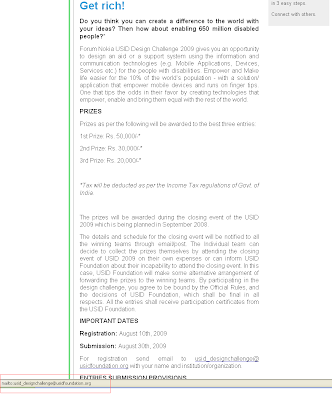
First email (real one): One good friend of mine sent me a mail advert recently about USID challenge 2009. Below is the snippet of same......I registered by sending the email to email ID shown in red box........


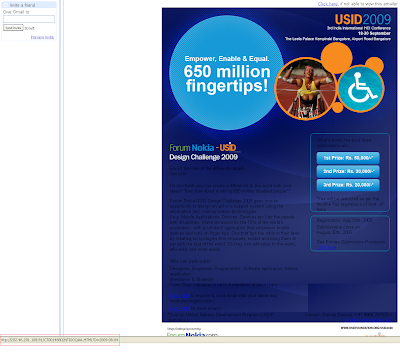
Second email (Fake one): Then I get another mail about the same event but this one looks more fancy.......this one also comes from a good friend. Something which made me read this mail was, I didn't get registration reply when registering through the address on the first email. You can see the screenshot of the same advert below ( I am using the screenshot as I don't want to spread the attack myself :P but one can see the url of malicious website in the redbox in bottom left ....thanks to Mozilla Firefox 3.5)


I am really impressed by the ingenuity of the spammer/attacker as here the mail didn't came to me as a random email but from someone trusted. So the attack searched for me ..... :)

They knew that the event is recent .....so they were mixing familiar names with malicious links (some of the URL's point to trusted portals like Forum Nokia). Since the event info comes through network ....it reaches to a person who has a high chance of clicking on it. So, the chances of the attack being successful are even higher.

Lessons to be learned:

1. Have upgraded browser and working one (like Firefox) , which can tell you that the website you are trying to open is malicious.
2. Even though mail comes from a trusted source ....... first hover over the link before clicking on it ......if it is something malicious...I am clicking on! (like the one in above image is just an IP )
3. Inform your network about it ...so that they stop spreading attack........but inform them in a smart way (by not spreading it again) ........ :)

Thursday, July 30, 2009

app store.....music store ......why not "charity store"?????

We are living in an age of exponential times.....things change very fast and it is easy to channelize energy in the required directions.

We have open source ....to have free software ....break monopoly or whatever reasons you can thin of.....then we have "causes" on facebook , people can recruit facebookers for their cause etc.

you can also see .......websites which have donation indicators to attract donations from its fans....like wikipedia........and yes ....these instruments work........

whenever I am roaming around in campus and get a glimpse of people who are having some T-Shirt/bag etc which support some cause.....it makes me go thinking......why do not I buy everything i need...trouser,shirt,shoes....supporting my causes......there might be a way to buy a cap from Mozilla store.....Tshirt from Ubuntu site........but why do not we have a web store which is a charity aggregator.....so that when I am about to buy something .......i can check on this web store charity aggregator and find if my purchase decision could support some charity .........

So....once you have a cause which needs money .....and you have some accessory which people might want to buy to support the cause.......you can submit that apparel/accessory on this web store and people can buy it.......

Once this web store becomes popular we can have the physical manifestation of the same.........you can walk into your favourite shopping mall and enter into this charity store and buy stuff for the cause you support....

However, this webstore does not need to be an independent portal but could have presence on existing social media portals like Facebook etc or it could be just extension of the existing players in business....like amazon charity ....... :)

In the quest of ultra cheap marketing trick

I have a small business interest in Bangalore, India ..... and I am always looking for some ultra cheap and effective marketing tricks........

Some basic philosophies which were subconsciously in my mind

Rewarding people who help you spread the word, get the right ideas, or help you identify the problem....
  • rewarding them can be through a monetary prize, some food coupon or any other privilege
  • rewarding by recoginition.
Then today I was watching this MIT world series video, which is about using prize as an instrument to do breakthorugh innovation.

The video summarizes essentially two points which prizes/competition can help you solve:
  • Generating ideas
  • Solving some identified problem
It also mentions that organizing a competition lowers the cost and people who participate end up doing more then the economic gain they can make. ( humans somewhat become irrational while entering a competition)

So........I am now much more strong believer in this instrument of organizing a competition .....whenever I need to get some ideas or a problem which I know I cannot solve .... :)

Sunday, July 26, 2009

Future for India

Few days back at dinner we had quite long discussion about sectors in which India must invest. I had vague thoughts about the subject from my previous readings and understanding of the subject.

However, in my ToDo list I had a video to watch...which comes from a book author .....the video is from MIT world series and publicly available.

This video has some interesting comparisions and lessons for India, because we have lot of similarities with China (Huge rural population is one........)

Saturday, July 25, 2009

3 email strategy

I was thinking about the email account strategy for quite some time now. I would like to share my solution which uses email accounts in a special way. They are not solving all the problems but atleast the ones I had and no doubt there might be better solutions......hence this post.

So, first my problems.............

1. I feel concerned about checking my mail on others/public computers/devices.
2. I do not want to tell everybody my email....I want a cover.

Solution:

Let's take my primary account is b@xyz.com and I have two other accounts which I have created to solve these two problems. Let's name these accounts a@xyz.com and c@xyz.com. We live in a world where email account is free so we can always waste some.


Now my solution

First part :

I try to give c@xyz.com for all public subscriptions, newsletters etc. And forward all my mail from c@xyz.com to b@xyz.com. So, now something which I don't want to see coming from could be filtered at c easily. (it is possible to do filtering even at b but I like it that way ...more neat and clean and I get email masking)

Second Part:

I forward all my emails from b@xyz.com (except few) to a@xyz.com. Also, publicly my friends do not know that I use c for mailing them. So, there is no reputation loss when somebody mails from a on my behalf.

Now whenever I am at friends place can easily check my email through a@xyz.com . I try to delete all of them when I read them . so I always have only latest ones. So, even if somebody can get my account a@xyz.com I can change the password later (as it is tied up with the primary account for recovery) and the loss is minimal. (because this account has no reputation so mailing from it will not bring me any losses for reputation)

So if I try to make a flow:

(email publicly known @ Public forums ) c@xyz.com -----> b@xyz.com (check mail @ home also has strong password) -----> a@xyz.com (to check mail at public places)

Would like to know feedback and have comments......

I wish that good email providers could provide all this functionality in one account......if there are any good points in it .........

Wednesday, July 22, 2009

SPAM and analogy from dinner

We were having dinner (indian food) with friends. The rice had some spices (Bay Leaf) in it. See the picture below:

21072009439 - Share on Ovi

You can see the bay leaves seperated from the rice. Now the question was would you do it before you start eating your food. So, that you have a comfortable ride then on ....or .....remove them as you eat.....maybe depends on how hungry you are.....


Now the parallel analogy is ..... you get emails but there is SPAM in it ....do you delete them first or delete them on the run as you read.


So I had this thought while eating dinner with my Indian friends and I mentioned it to everybody. One guy who was yet to eat...... I told him about this hypothesis that ....since he has removed all the bay leaves before start eating his food .... would he also like to delete SPAM before reading emails ........surprise surprise ! he says yes!

I am not saying there is any correlation, but maybe there is ??? ... the readers of this post might want to check for themselves.

My hypothesis is that is not only about food eating but this behavior might be part of the personality, you prefer to clean your study table before you start studying etc. This behavior might also spillover into your mail/spam deleting habits.

Friday, July 17, 2009

Links for the FREE audio book

I was eagerly waiting for Chris Anderson's next book FREE. It is now there and available for free (with some limitations, only audio and ePrint on Scribd, Google books).

Links for the Audio book:

1. Audio Book Unabridged: Link
2. Audio Abridged (It is not free, but from this link can be obtained by entering the email id) : Link
3. eCopy from scribd (maybe this opens only within USA)

Wired post covering the story on book.

Friday, July 10, 2009

U.S.A: A society of experiment!

I was recently watching the "The century of self", a B.B.C documentary. The documentary shows the various cultural transformation which were pushed and influenced by some major psychologists/psychoanlaysts.

Some highlights of the documentary:

Phase A:
  • Invention of public relations. Invention of Advertisement, appealing to the irrational self of a consumer (Sigmund Freud: human behavior is guided by unconscious sexual and aggressive drives). However, this approach failed after recession. (due to over production)
  • Paradox of making people choose (the elite want people to have a rational choice which is better for all) and still making it look like democracy. (so ultimately manipulating the choice of consumers)

Phase B:
  • Free society by liberating the consumer, over feeding the desire.
  • Lifestyle marketing.
  • Self actualization. (Focus groups vs psychological market research)
So , the open question is "if people are irrational", building a feedback mechanism as in ideal democracy will make irrational decisions. Do we need a leadership which takes the vision of people beyond their own selfish needs or they must just cater to their short term demands.

Thursday, July 09, 2009

Innovation for telecom operators (service store)

I was discussing with a friend about possibilities for mobile operators. (apart from being bit pipes do they really have a case for doing something else in future)

There were main points which we thought a mobile operator is different.

1. For users to experience a service through a mobile, operator can get a lot of first hand data and a better sense to customize and improve the service.

2. Paying for a flat Internet connection like 15 Euros per month in Finland and similar amount elsewhere. Is there still some latent demand which might be satisfied if the price to be paid was less.

As the discussion progressed I came to the conclusion that a new type of business model is possible for mobile operators. which is somewhere in middle of Flat rate and Pre-Paid (or pay as you use)

The proposal is to charge user per service. Say, you are an avid facebook user, the mobile operator will provide you a widget or some other access point in your mobile by which you can access facebook unlimited! (The price is definitely lower then flat rate and pre-paid)

So, as a user if you are not an explorer on Internet and consumer of 2-3 standard Internet services. You might go with this kind of an offer, where an operator can charge you something like: 2 Euros per month for facebook and 3 Euros per month for Youtube (maybe higher because of video content). So, if you are only doing facebook and youtube. You end up paying just 7 euros per month.

From the operator vision, they can create a service store from where people can buy such service pakage for 1-3 Euro each (price depends on the market, this is say as per scandinavia). Like the developer community on other platforms (iPhone, Facebook) , here we have the third parties (Google, Yahoo or a freelancer etc) who can provide there customized widgets on mobile operators service store. There can be a revenue sharing between third party and mobile operator.

Also, Operator can build a colloborative filtering support in the platform and provide standard API's to the service developers and provide users of the service a unique experience customized as per their local network.

This business model would be an equivalent of micro payments in other platforms. Where you (as a user) can buy less demanding services for unlimited use at a much cheaper price. (say even 10 cents, which might be just a weather update from Internet )

It is also combining the bandwidth cost and application cost in one package. (Like amazon kindle where you don't pay for the bandwidth , most customers don't even realize that)

Wednesday, July 08, 2009

New Google Chrome OS

It was just few months back , when I was complaining to my friends in Otaniemi. That why don't we have a device which just boots in a web browser.

I don't remember when was it last time I felt I need any other software on my laptop. (Mostly Mozilla, also some ocassional use of VLC and Open Office)


Now we have today the announcement of Google ChromeOS coming from Google. I don't know will google OS boots up directly into browser on a netbook or any other gadget. But, atleast there might be a chance!

Tuesday, July 07, 2009

Future of social media and how it effects India

Out of many value propositions which I could/(or could not) think for social media, one which has just struck me is "Reputation and Trust management".

In the ideal world of high Internet penetration, where every body is on some sort of social networking site. We will have every body connected to somebody (with some exceptions). The creation and identification of trust from reputation would be much easy, especially in the places where it is not that easy now!

Like we already can see role of recommendations on LinkedIn for getting a job. Recommendations do exist in real world but hard or costly to have. In online networks they exist in black and white, easy to access and persists for ever!

Some of the things we (Govt.) ought to do in physical world, where people intend to do some fraud for greedy reasons, like what is mentioned here in an article of Times of India. These problems could be solved effectively with use of online social networks and crowdsourcing.

I am taking some basic assumptions about India here:

1. Coming from India, I know that we have a society where most of the people know about people around them, which is very different from west! So, it is very easy for people to vouch for others (their near and dear ones).

2. Too many people, lot of contribution possible. Success rate for crowdsourcing the effort!

Now one of the problem posed in the article is that govt. want to issue id cards and then they are issued to people who do not even exist and execution fails.

So, what I propose is a wikipedia kind of solution where people can create people database. Let's call it peoplepedia.

Allowed functions for peoplepedia.

1. Creating a node, which is essentially a living person (say in India ) which can be later dead and the status change can happen accordingly.

  • Node will contains the name.
  • The gender.
  • System will issue a unique id to every node.
  • Anybody can create/ delete a node.
  • The system will have a CAPTCHA like solution to prevent non-computers to make fake nodes.
2. Linking to another node, if one thinks they know each other.
  • People can also indicate the relationship when linking. Like relative, friend, NGO, third party etc.
3. Bootstraping this database from existing social networks like Facebook and Orkut. (as chances of having real living users on those networks are high)

4. To users people have a graphical interface to search people based on their unique id, name or social graph neighbors.

5. Optional could be users adding more details to a node which could be private data like passport number etc but then which might need a login/password protection. Although this is not the real value of this database.

6. Since it is a people driven project and people identify the people they know in real life , which gives the trust in the numbers. Also, more people linking to a person will add to the reputation of a person and database can have an indicator based on who links to the node and how many links to the node. Let's call this indicator lively index, which would mean, the chances that person is real and exists/existed in this world ! However, the loss of privacy will happen in form of identifying somebodies social network but since we do not have any other details about that person (apart from name and sex) the privacy loss is minimum.

The cost of the project must not be high but the value it can provide with a small percentage of population actively involved would be high.

It would be a dynamic snapshot of number of real people in the country and also giving the break up (like men and women)

This platform can then be used for vouching for people, for distributing cards / other goods. Although it would not be highly reliable but could boost the confidence of identifying the real person.

I welcome readers of this post to improve the concept as it is in very initial stage and I have the feeling that it can be improved a lot!

Friday, June 19, 2009

Research Questions

Recently, I have started focusing on the "cultural impacts on social media". Somewhat related to this, I was reading an essay on " Is there anything good about men?" @ http://denisdutton.com/baumeister.htm . (Although, the essay is 39 pages long but is very good read)

In the essay, the author talks about men and culture. Where, I could find some parallels with some concepts in economics (The concept of Comparative advantage ) I could relate from the essay that men had/have an edge because of comparative advantage over women. (not because they are more intelligent but of the nature of social network they have)


Research question: Among men/women who is more/less vulnerable on social networks because of the nature of their social networks. (large and shallow vs small and intense)

Moreover, I was just wondering that, if concepts of International trade are applied within a nation, where every individual is treated as a nation and a comparative advantage could be computed. So, people choose professions accordingly and increase the overall productivity of a culture or nation. (However that might be the natural course of action for a society)

Wednesday, May 13, 2009

my current research interests about privacy in LBS

Palen Dourish's work in privacy in networked world is something which has really influenced my thesis work. I found his video from LIFT'08. ( I wish i was there in 2008 too!) 


Also, recently I stumbled upon the Google Tech Talk about privacy enhancement technologies for LBS. (using homomorphic encryption)


Sunday, September 28, 2008

Some interesting videos I have seen.

Since I am always watching something. So this list needs to be frequently updated.

Category: Google Tech Talks

1. The paradox of choice: Barry Schwartz.

2. Human computation, Luis Von Ahn , Google talk. (I have also attended updated version of this live at CERN)

3. Second Life .

4. How to break web software.

5. Biofuels: Think Outside The Barrel

6. Reverse engineering techniques to find security bugs: A case study of the ANI

7. Graphing calculator (One of the most amazing videos, I have ever seen!)

8. Crime: The Real Internet Security Problem

9. Neuromarketing

10. Creative processes in Science and Technology

11. Twitter

Category: BBC documentaries

1. An Islamic history of Europe

2. The Story of India: Part 1-6

3.a. Clash of the Worlds (Episode 1 of 3): Mutiny
3.b. Clash of the Worlds (Episode 2 of 3): Sudan
3.c. Clash of the Worlds: Palestine

4. In the footsteps of Alexander the Great

5. BBC Four - The Smell of Paradise

6.a. Politics - The Power of Nightmares, (Part 1/3), “Baby it's Cold Outside“
6.b. Politics - The Power of Nightmares, (Part 2/3), “The Phantom Victory“
6.c. Politics - The Power of Nightmares, (Part 3/3), “The Shadows in the Cave”


Thursday, September 25, 2008

Summary of my Internet browsing in terms of bookmarks.

category: mobile phones: general

1. http://www.intomobile.com/2008/08/28/us-mobile-users-break-sms-text-messaging-record.html
2. http://googleblog.blogspot.com/2008/09/future-of-mobile.html
3.Apple-A-Go-Go: iPod Touch With WiFi Music Store; SBUX; iPhone Price; 95M-Plus Videos Sold - Forbes.com
4. http://research.nokia.com/news/otaniemi.html
5. The Mobile Technology Weblog: Texting Injured 6 Million Brits in 2007
6. Bank cashes in on love of mobiles - Yahoo! News
7. http://hdvoice.tmcnet.com/news/2008/07/24/3566547.htm
8. WirelessDuniya: Mobile VAS,Mobile User Experience,Mobile Communities & India Mobility Blog
9. Open Handset Alliance

category: mobile : intersting ideas + design innovation

1. http://conversations.nokia.com/home/2008/08/video-hava-mobi.html
2. http://www.touchusability.com/2008/09/tilt-scrolling-with-instapaper-iphone-app.html
3. http://www.intomobile.com/2008/09/22/new-liquid-lens-technology-uses-sound-and-water-for-smaller-cameraphones.html
4. http://www.intomobile.com/2008/04/19/video-francesco-cara-nokia-design-strategist-we-need-a-new-metaphor-for-mobile-interaction.html
5. BBC NEWS | In Pictures | In pictures: Mobile design competition
6. Nokia perfects the clicky tactile touchscreen - iPhone gnashes teeth, swears revenge - The Red Ferret Journal
7. http://www.pacificepoch.com/blog?id=P127953
8. http://www.nearfield.org/2008/05/thoughts-on-nokias-nfc-developments

category: mobile: social impact + user research

1. http://news.cnet.com/Brazil-Digital-inclusion%2C-but-how/2009-1042_3-6245405.html?part=rss&tag=2547-1_3-0-20&subj=news
2. sociable media // articles by Cliff Atkinson

category:design+visualization:general

1. http://www.nytimes.com/2008/08/17/technology/17ping.html?_r=3&oref=slogin&oref=slogin%20I&oref=slogin
2. http://www.businesstobuttons.tv/webtv/94.html
3. http://scottburnham.com/?p=75
4. http://gizmodo.com/5017972/story-of-a-peanut-the-tivo-remotes-untold-past-present-and-future
5. http://www.economist.com/specialreports/displaystory.cfm?story_id=10950394
6. Graphics and Web Design Based on Edward Tufte's Principles
7. cazh1: on Business, Information, and Technology: The Good, the Bad, and the Ugly of Powerpoint
8. Presentation Zen: The "Lessig Method" of presentation


category:Music:general

1. http://blogs.computerworld.com/microsoft_takes_on_ipod_with_zunes_buy_from_fm

category:Internet:general

1. PCs Losing Their Relevance in Japan: Financial News - Yahoo! Finance
2. http://googleblog.blogspot.com/2008/09/future-of-search.html


category:security:general

1. http://yro.slashdot.org/article.pl?sid=08/08/27/2246235&from=rss
2. 0day: PDF pwns Windows | GNUCITIZEN MyStrands - Social Recommendation and Discovery
3. http://www.paranoia2007.com/index.php?page=13&id=55
4. http://it.slashdot.org/article.pl?sid=08/08/12/0144220&from=rss
5. http://www.nytimes.com/2008/08/10/technology/10digi.html?_r=1&sq=password&st=cse&adxnnl=1&oref=slogin&scp=1&adxnnlx=1218452878-PeWJoEZJXHJ0Ye089LRT+w
6. http://radar.oreilly.com/archives/2008/06/malware-havens-most-studies-pl.html

category:general :interesting ideas

1. http://www.hothardware.com/News/Capturing-3D-Surfaces-Simply-With-a-Flash-Camera/
2. Pod: Fast and easy headphone cord wrapping - Lifehacker

category:general:news

1. Netizen Debate Ensues Over 'Dog Poop Girl' - OhmyNews International
2. PRI: Public Radio International: National and World News, Talk, Arts, Entertainment and Music
3. World of Ends
4. http://www2.goldmansachs.com/ideas/brics/index.html
5. An Open Facebook API vs Google OpenSocial - Blog Maverick
6. Innovation in Business Models

Wednesday, April 09, 2008

videos with no real time questions. :(

I was watching this user interface design video from google tech talk series: "Don't make me click".
After watching that I felt, as I was watch lot of these videos, what if i have some comment or question and I want to enjoy the video same as, as if I was there.

Can google provide me an interface to ask question on that very moment and do some NLP from comments on video and figure out my answer (like the concept of 1 player game and zero player game, prof. Luis von Ahn speaks about this in another tech talk)

Moreover when a video is more popular, comments are many which are most of the times containing much more pointers than original video. But, I don't see anybody providing an easy access to this gold mine. :(

Thursday, April 03, 2008

Something from my past which connects to future.

I could remember the day very clear, as in my 3rd year of b.tech(around 2004), I found this research project making a chip based fan, I chose that as my topic of presentation for some thing as emerging technology. Today I saw an article on computerweb, mentioning about this technology being available now as a finished product, I feel some how happy! although I haven't done anything related to it.

link to the product video.

Saturday, February 02, 2008

Some new bookmarks and ideas.

  1. A nice article about the people who keep on traveling and their means of surviving.
  2. The history of communicationThis webpage describes events on the timeline, what has happened to the means of communication.
  3. Using camera phone as a mouseA very new idea, where researchers are trying to find some more interesting ways to use a camera phone as a mouse.
  4. BitTorrent for carsA new approach to use P2P. Interesting!!!!
  5. Dynamic Time-Travel Maps From MySociety and Stamen A good visualization of maps with new dimensions.
  6. Thermo - Adobe LabsA new Adobe product, looks good and promising, especially to do UI's!
  7. Brad's Thoughts on the Social GraphThe use of Social Graph.